
Home / Laureates / Rei Kita
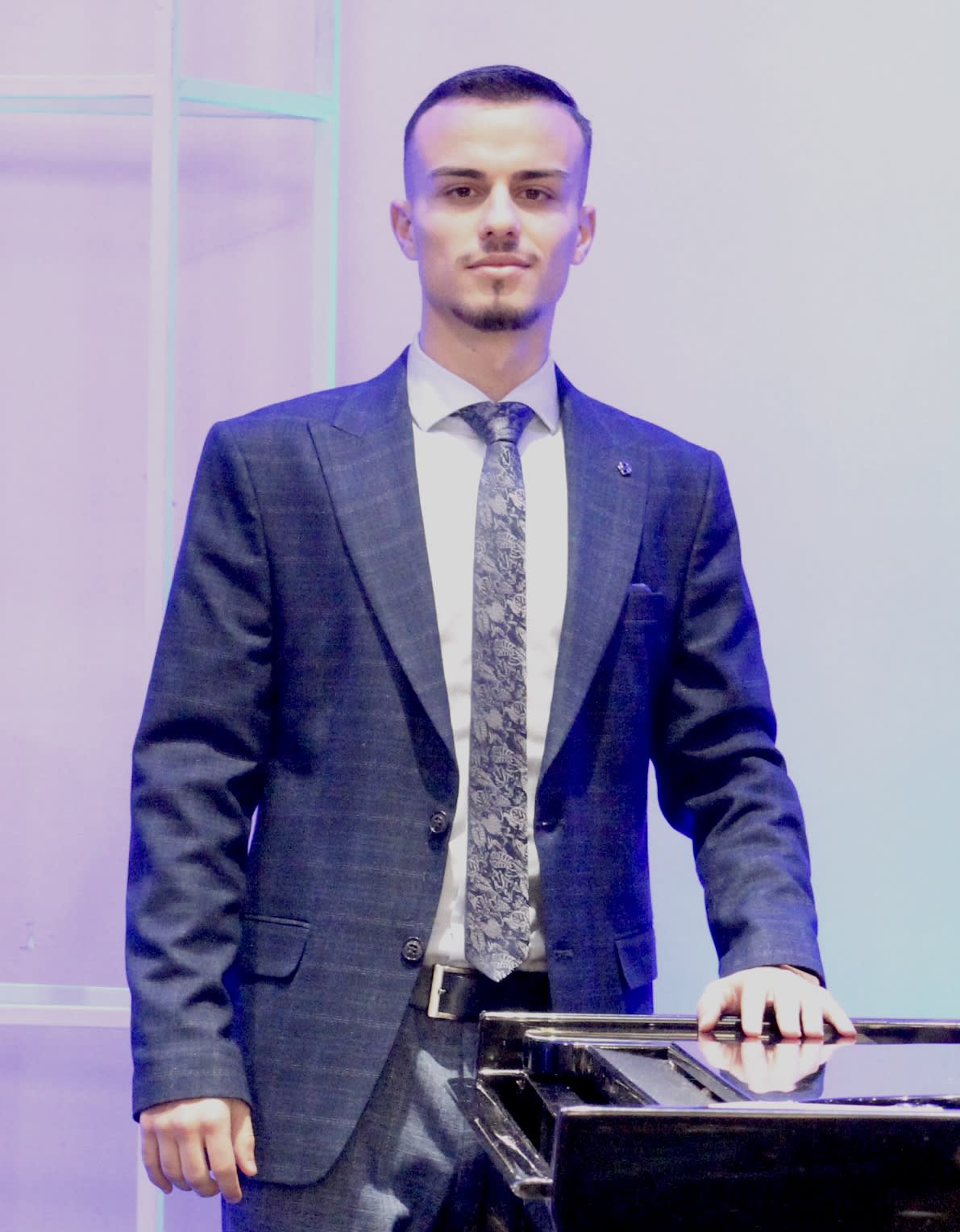
Portrait of Rei Kita
Laureate

Rei Kita

Albania

My name is Rei Kita, and I am a composer and pianist. I completed my 12-year musical education at the Jordan Misja Artistic Lyceum, specializing in piano (2011–2023), where I graduated with excellent results and was awarded a Diploma of Excellence. Since October 2023, I have been pursuing my studies in composition under Prof. Aulon Naçi, Director of the National Theatre of Opera and Ballet. At the same time, I serve as a Student Representative of the Faculty of Music and as a member of the Academic Senate of the University of Arts (four-year mandate). I am also a member of the Student Council (two-year mandate). As a pianist, I have performed in recitals, concerts, and various competitions across Albania from 2016 to 2023. In May 2023, I gave a solo recital at the Tonin Harapi Concert Hall. I have also participated in competitions such as EPTA Albania and the international competition “The Young Pianist” in Kosovo. As a composer, I have received several international awards and have presented my works in concerts both in Albania and abroad. During the 2024 concert season, one of my compositions was performed alongside works by composers such as Wolfgang Amadeus Mozart, Ludwig van Beethoven, and Sergei Rachmaninoff in the concert “Moment Without Time” at the University of Arts. In May 2024, I presented premieres of my works at the Çesk Zadeja Hall, while in December 2024 my music was performed at the international festival “Pianodrom,” dedicated to Albanian composers, where I was featured alongside composers such as Aleksandër Peçi, Feim Ibrahimi, and Tonin Harapi. On June 16, 2025, my work was performed in a concert program at the University of Arts, where I was introduced as a young Albanian composer. In the same year, I represented Albania and the University of Arts in an inter-university collaboration between Albania, Kosovo, and North Macedonia, where my work “Re’verse Etude” was performed in North Macedonia. My musical output spans a wide range of genres, from chamber music to symphonic works, including compositions for solo piano, ensembles, vocal music, and orchestra. Among my works are: “Re’verse Etude” (piano solo); “Le lacrime della Terra” (string quartet); “Variations on the Arbëresh songs ‘Moj e bukura More’ and ‘E lule lu’” (piano solo); “In the Garden of My Sorrow” (vocal romance); “Gjurmë” (clarinet and piano); and “Waltz of Nostalgia” (symphony orchestra). I have been awarded several international prizes as a young composer of contemporary classical music, including: First Prize at the “World’s Best Musicians Competition” (Warsaw, Poland, 2025) Silver Award at the the “Brahms International Music Competition” (Gdańsk, Poland, 2025) First Prize at the “Gabriel Fauré Music World Competition” (Puglia, Italy, 2025) First Prize at the “Debussy International Music Competition” (London, United Kingdom) One of my most recent concerts is “Reflections” (November 15, 2025), held at the National Theatre of Opera and Ballet, where my string quartet “Le lacrime della Terra” was premiered; a work that was later awarded First Prize at an international competition in London.

Latest Recognition
  • Gold Prize with Special Mention
Composition
Beethoven Award International Music Competition — 2/2026
Awards & Recognitions

A timeline of recognition

Beethoven Award International Music Competition — 2/2026
Composition
Gjurmë ( Trace ) - for clarinet and piano (2026)
  • Gold Prize with Special Mention
Brahms International Online Music Competition — 2/2025
COMPOSITION
"Re'verse Etyde" (Work Analysis) A musicial reflection on two notes that share a name , but not a nature. This piece is not an Etude in the traditional sense of the word. It is a path turned backwards, a rebellion against the expected flow of pianistic development. It begins not with an initiative, but with conflict, an inner tension that neither starts nor ends:it is always there. It is the very substance of the work. My name Rei , shares the same initial syllable as the pitch that forms the gravitational center of the piece : D ( Re ). In this way, "Re'verse Etyde" becomes a sonic reflection of my own name as a composer; a return inward,but also a transcendence beyond the self. "Verse" implies not only a reversal,but also a poetic line , a structure that becomes a study of existential tension, living between two nearly-identical notes that never truly become one. This is an aesthetic self-reflection :an Etude that is,at its core, a reversal of my own name,an exploration inward through the voice of the instrument. Natural D and D-flat are two poles in constant collision,like two mirrors endlessly reflecting one another, never quite touching the origin. In this unending play, the pianist becomes the mediator between two irreconcilable truths. Each key pressed is a choice ,but also a hesitation. Each chord a call ,but also a doubt. The pianism in this work is philosophy: it does not aim to decorate, but to examine. It does not serve harmony, ti challenges it. The fingers do not move across the keyboard to build, they dig,to uncover a reasoning that lies behind each timbral vibration, behind each D that is chosen, only to be later denied by another D that resembles it, yet is not the same. "Re'verse Etyde" is an attempt to live within a contradiction. It is the awareness that,at our core, we are always in between ;between decisions, between what is and what could have been. In this space,tension is not a dramatic device, it is a way of existing. And whem silence returns,the question remains: Were we listening to an Etude,or to a reflection of our own spirit caught between its own versions?!
  • Silver Award
World's Best Musicians Competition — 2/2025
Composition
"Re'verse Etyde" (Work Analysis) A musicial reflection on two notes that share a name , but not a nature. My name Rei , shares the same initial syllable as the pitch that forms the gravitational center of the piece : D ( Re ). In this way, "Re'verse Etyde" becomes a sonic reflection of my own name as a composer; a return inward,but also a transcendence beyond the self. "Verse" implies not only a reversal,but also a poetic line , a structure that becomes a study of existential tension, living between two nearly-identical notes that never truly become one. This is an aesthetic self-reflection :an Etude that is,at its core, a reversal of my own name,an exploration inward through the voice of the instrument. Natural D and D-flat are two poles in constant collision,like two mirrors endlessly reflecting one another, never quite touching the origin. In this unending play, the pianist becomes the mediator between two irreconcilable truths. Each key pressed is a choice ,but also a hesitation. Each chord a call ,but also a doubt. And whem silence returns,the question remains: Were we listening to an Etude,or to a reflection of our own spirit caught between its own versions?!
  • 1st Prize