
The Sound in Which I Was Raised
For Portuguese composer Gualter Miguel Ávila Da Silva, music is inseparable from the volcanic landscapes and philharmonic traditions of his native Azores — an environment that continues to shape his approach to contemporary soundscapes.

Gualter Silva grew up on Terceira Island in the Azores, beginning his musical development within the local philharmonic tradition before studying at the Regional Conservatory of Angra do Heroísmo. As a composer, his work integrates traditional cultural roots with contemporary soundscapes, often drawing directly from the natural environment of his homeland. Recently named Absolute Winner in Composition, he reflects on finding music in nature, writing for wind ensembles, and bridging past traditions with future innovation.
Where does a new composition usually begin for you—do you start with a clear structural outline, or does a piece grow out of a single sound or idea?
When I compose, I usually begin in one of two ways: either from a conceptual idea or from an emotion. An idea might come from a story that inspires me to set it to music. An emotion or feeling might arise from an imagined melody, or from a sentiment that moves me — for example, my love for my homeland often inspires me to create. Its traditional melodies inspire me to recreate them, and its natural environment surrounds me; as a creator, the sound in which I was raised has always been around me, and from it I became a composer.
Your winning piece, No Ventre da Mátria, has a powerful and evocative title. What was the original image, story, or feeling that sparked this composition?
No Ventre da Mátria has a title that directly reflects the performance of the piece. No Ventre means “inside”, much like the womb of a pregnant woman. Mátria is a term coined by Natália Correia, a major feminist activist from the Azores, referring to Mother Earth — the land where we were born and where we are shaped.
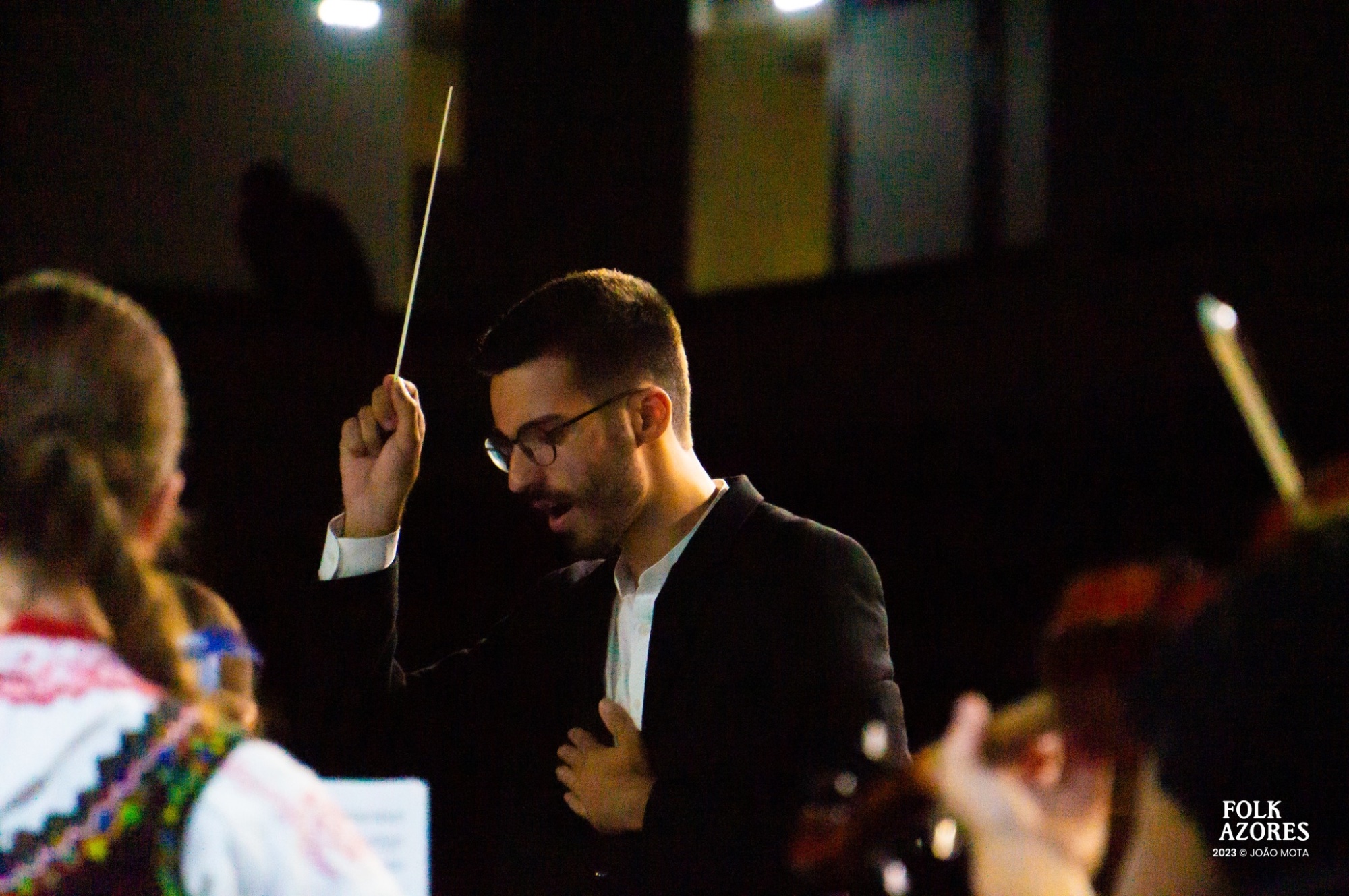
The piece was performed in the crater of an active volcano on Terceira Island, with some moments even played inside the volcano itself, making it truly music from the womb of the mátria.
Anyone who stops to listen to the natural sounds of the Azores will recognise the authentic sonorities I try to convey in the piece. The entire work seeks out the sounds of nature, whether inanimate or animal, and I believe that connection was successfully achieved.
One of the jurors described No Ventre da Mátria as “a complex philosophy, but the music speaks for itself.” Do you see your work as carrying a philosophical message, or do you prefer to let sound communicate without explanation?
I feel that my music conveys a philosophical message — the truth of sound. Is every sound music? For me, yes, when the intention is for that sound to become an artistic object. It also carries a message of preservation: showing the audience that nature and its sounds must be protected so that they are never destroyed. We may explore, but never damage.
In terms of artistic material, however, I believe it is very direct — it makes one think, yet it remains clearly rooted in the actual sounds of natural soundscapes.
Much of your catalogue is written for wind band and wind ensemble — a tradition deeply linked to Portuguese community culture. What draws you to this medium, and what possibilities do you find in it that other ensembles don’t offer?
What draws me to the wind ensemble stems from my foundational training. I come from the philharmonic wind band tradition, which means I know this family of instruments intimately and have always been accustomed to writing for them. They are the instruments I understand best, which is why I write for them so regularly.
It is not that other instruments have nothing to offer — they certainly do — but I simply feel much more at ease with winds, as my entire career as an instrumentalist has been centered around them.
“Is every sound music? For me, yes, when the intention is for that sound to become an artistic object.”
Gualter Miguel Ávila Da Silva
What do you hope listeners feel when they hear your music for the first time?
I hope to transport listeners into a natural world — almost as if they were taking a journey to a volcano or a forest without needing to see it. Something else I like to convey in my works is a certain sense of calm, which is part of the very essence of my people.
I love my land and my people deeply, and I try to turn everything good they give me into art — something considered and refined.
You’ve spoken publicly about the cultural and social importance of Azorean philharmonic bands. In your view, what is the role of tradition in contemporary composition? Can the two coexist without compromise?
Philharmonic bands in the Azores, as in Portugal generally, are the primary centers for training musicians. Without these bands, less than half of the music made in Portugal would exist.
Their role in contemporary music lies mostly in the way we write for them: ensembles made up largely of amateur musicians present certain limitations, so composers must adapt their writing accordingly. But that is an interesting challenge — how to convey an idea without relying on every advanced technique available to the composer.
Tradition is deeply important in contemporary composition; there is no future without a past. The past exists to be remembered and kept alive, while the future is there to be explored and innovated. With this mindset, tradition and contemporaneity can truly coexist.
Looking ahead, what artistic paths are you most excited to explore — new ensembles, new styles, collaborations, or perhaps a larger project that you hope to bring to life?
Looking ahead, my aim is to consolidate the musical language I have been exploring — that of the soundscape — and to bring it to new ensembles. I am always seeking collaborations for joint projects. My main goal is to establish this aesthetic and to make my homeland — and inevitably my art, as the two are inseparable — known throughout Europe.
Read this interview as a magazine edition
The designed Maestro Magazine edition of this conversation.